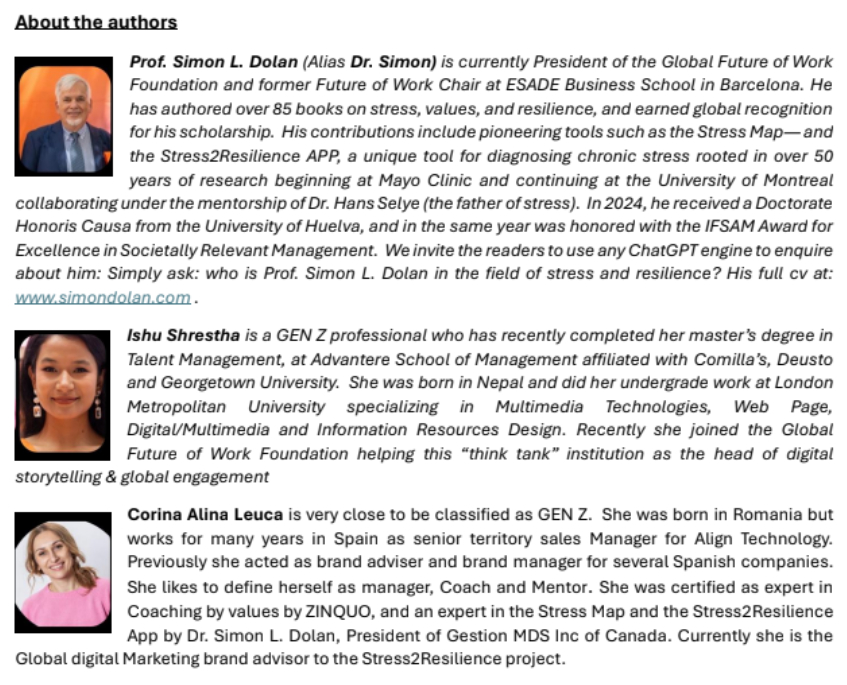


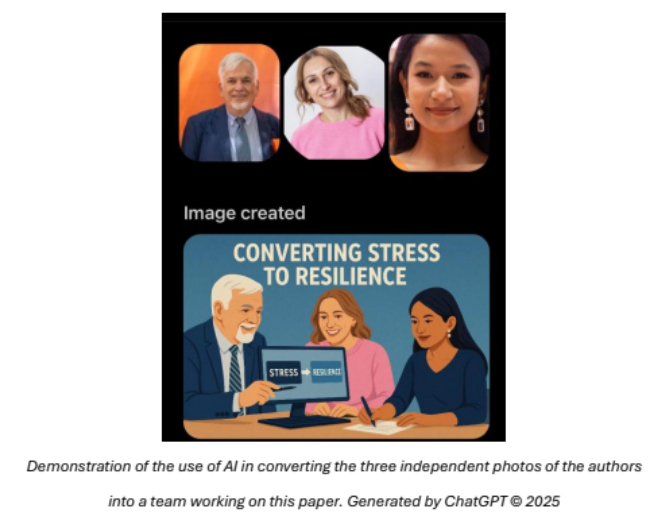
By: Simon L. Dolan, Ishu Shrestha and Corina Alina Leuca
Introduction: The Growing Importance of Resilience
In a world marked by disruption—from pandemics to geopolitical conflicts, automation to AI—the ability to bounce back, adapt, and thrive has become more essential than ever. This core trait, known as resilience, is no longer just a personal asset but a strategic imperative for organizations and societies alike.
At the forefront of this global conversation is Prof. Simon L. Dolan, a world-renowned expert in stress management, values, and the future of work. Through decades of research, Dolan has developed unique frameworks and tools to help individuals and leaders shift from chronic stress to sustainable resilience. Now, artificial intelligence (AI) offers the opportunity to scale these tools and make resilience-building more accessible, timely, and personalized.
According to Professor Dolan, resilience can be understood as the capacity not only to withstand challenges and setbacks but also to adapt, grow, and emerge stronger from them. It embodies a positive mindset and an ability to navigate difficulties while maintaining focus on goals and well-being. In his writings, Prof. Dolan emphasizes that resilience is not merely about bouncing back; it’s about transforming adversity into opportunity. He asserts that fostering resilience involves nurturing an environment that promotes psychological safety, encourages flexibility, and values continuous learning¹. In other words, resilience is our capacity to adapt and bounce back from adversity—is crucial in today’s world of rapid technological change, economic flux, and evolving work norms. It is a defining competency for individuals, organizations, and societies alike.
The objective of this short article is to synthesize the pioneering work of Professor Simon L. Dolan, over the past 50 years, and to define the current and future agenda in embedding AI into the art and science of promoting resilience and well-being.
¹ Dolan S.L. (2023) De Stress at Work. London, Routledge.
Welcome to the AI Generation: Victims or Winners of the New World of Work?
From smart assistants and algorithmic suggestions to AI-generated essays and virtual interviews, Artificial Intelligence has woven itself into the fabric of our daily lives. For Gen Z, who grew up with this technology, adapting comes naturally—but that doesn’t mean it’s stress free.
As AI raises the bar for speed, efficiency and performance, many individuals, especially students and young professionals, are feeling overwhelmed. The unspoken pressure to “keep up with AI” is real. But unlike machines, humans require rest, reflection and emotional care. This is where the concept of resilience becomes more important than ever².
² Ishu Shrestha and Corina Leuca have two compelling reasons for collaborating with Professor Dolan on this article. Firstly, as representatives of Gen Z, they bring invaluable firsthand insights and testimonials that enrich the arguments presented. Their unique perspectives and experiences are essential for bridging generational gaps and enhancing the relevance of the discourse. Secondly, with Professor Dolan’s extensive research and publications spanning over 50 years, Ishu and Corina have effectively harnessed the power of AI to identify and curate pertinent sources that bolster the core arguments. This collaborative effort not only adds depth to the discussion but also showcases the exciting potential of combining youthful innovation with seasoned expertise. Together, they are paving the way for a more informed and dynamic conversation.

As HR Specialists observing the workplace dynamics and the evolving technological landscape, it’s essential to approach the discussion around Generation Z (often referred to as Gen Z) and AI with both insight and optimism. The notion of whether Gen Z is a “victim” or a “winner” in the world of AI is not a simple dichotomy; rather, it presents an opportunity to view the intersection of technology and the workforce through a constructive lens.
Gen Z, individuals born approximately between 1997 and 2012, are digital natives. They grew up with the internet, social media, and smartphones as staples of their daily lives. This intrinsic comfort with technology means that they often embrace AI not as a threat, but as a tool that can enhance their capabilities and productivity.
AI can help Gen Z streamline tasks that would otherwise be repetitive or labour-intensive, allowing them to dedicate more time to creative problem-solving and innovation. For instance, AI-driven platforms can assist in data analysis, freeing young professionals to focus on strategic initiatives. Companies leveraging AI effectively are likely to experience increased efficiency, and who better to drive this initiative than a generation adept at navigating new technologies?
While AI presents incredible tools for efficiency, creativity, and connection, it also brings some unique downsides that can affect the mindset and resilience of young people today. Yet, understanding these challenges can empower Gen Z to navigate them more effectively.
One significant concern is the reliance on technology for social interactions. With AI enhancing communication through social media, many young people experience a surge of dopamine with every like, comment, or share. This can lead to an unhealthy comparison culture, fostering feelings of inadequacy and anxiety.
Additionally, the constant influx of information generated by AI can lead to information overload. The sheer volume of content can make it challenging for Gen Z to discern what is relevant or true, often resulting in stress and feelings of being overwhelmed. Embracing this challenge can help you develop critical thinking skills and hone your ability to filter information effectively. Setting boundaries around media consumption—such as designated technology-free times—can foster a healthier relationship with information and alleviate stress.
The competitive job market, exacerbated by AI’s role in automation, can create pressure and doubt about career prospects. Despite this, it’s essential to remember that adaptability is one of Gen Z’s greatest strengths. By focusing on continuous learning and embracing skills that AI cannot replicate—such as creativity, empathy, and emotional intelligence—you can turn these apprehensions into opportunities for growth and innovation.
Finally, the rapid pace of technological change can create a fear of obsolescence. However, by cultivating resilience and a growth mindset, they can view these changes as opportunities rather than threats. Engaging in lifelong learning and seeking mentorship not only builds confidence but also prepares you to thrive in an ever-evolving landscape.
AI and the Science of Resilience: From Stress to Strength
Resilience is often misunderstood as a fixed trait. Prof. Dolan’s work, including the Stress Map and the Stress2Resilience (hereafter S2R) app, proves that stress, when properly diagnosed, can be converted into growth. The S2R app offers a guided journey through diagnosis, personalized feedback and action.
The Stress Map is a valuable tool that therapists and coaches can utilize manually, incorporating various elements of gamification that resonate especially well with Generation Z. In contrast, the S2R offers a digital solution that brings similar benefits to the forefront—efficiency, speed, and the power of artificial intelligence. With advanced algorithms at work, S2R produces detailed diagnoses in a fraction of the time that traditional methods would require, reducing what used to take weeks or even months to just moments. This remarkable advancement means that the journey to resilience can now be mapped out more swiftly than ever before.
AI can enhance this journey in four ways:
- AI as a Diagnostic Ally – Using data to detect early signs of stress and burnout. Machine learning models can process behavioural, linguistic, or physiological signals (e.g., tone of voice, language patterns, biometric data) to detect early signs of burnout and stress. Integrated with the S2R platform, AI can enrich individual assessments and enhance real-time accuracy.
- Personalized Coaching at Scale – Chatbots can offer reflective prompts and daily support. AI-powered virtual coaches or chatbots—trained on Dolan’s resilience framework—can provide on-demand support. These tools can offer daily micro-interventions: reflective prompts, habit nudges, or emotional regulation techniques grounded in cognitive-behavioural science.
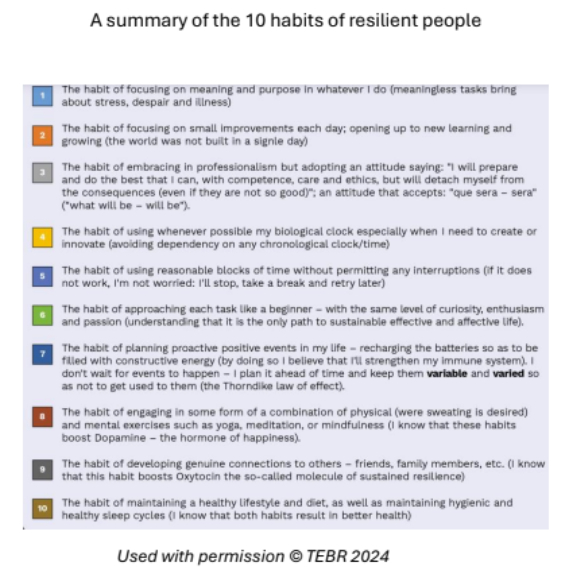
- Adaptive Learning – Using Dolan’s et al. “10 Core Habits of Resilient People”, AI systems can guide users through tailored learning paths. Based on user interaction, the platform adjusts its feedback and challenges, fostering long-term behaviour change³.
³ Simon L. Dolan, Anat Garti, Miriam Diez Pinol, and Pedro Cesar Martinez Moran (2024) The 10 Core Habits of Resilient People: Concept and Tools for Resiliency and Wellness Professionals, The European Business Review, Sept. 20.
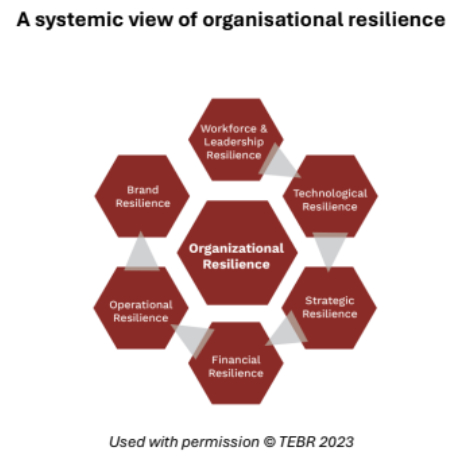
- Organizational Intelligence – Anonymous data insights to improve well-being strategies. As an example, Dolan and his colleagues introduced the concept of organizational resilience. They define organizational resilience as the capacity of an organization to anticipate, prepare for, respond to, and recover from adverse events while effectively maintaining adaptability and continuous improvement. Resilient organizations are characterized by strong leadership, effective communication, and cultures that encourage innovation and flexibility⁴.
⁴ Simon L. Dolan, Adnane Belout, Jean-Luc Cerdin, and Javier Casademunt (2023) Towards the Building of Organisational Resilience: Uncovering the Key Features, The European Business Review, May 27.
Human Uniqueness at the Dawn of AI
In 2021, Raich, Dolan, Ulrich and Cisullo wrote a seminal article warning about the possible implications of AI and intelligent machines not only on quality of life but also on well-being⁵. The article explores what human uniqueness may mean in view of the fast and disruptive development of AI and cyber-reality.
If intelligence is defined as the ability to cope meaningfully with different situations, we can compare natural and artificial intelligence. While machines do not think, they increasingly perform tasks once exclusive to humans. Nevertheless, these systems are algorithmic, mimicking human behaviour rather than replacing it.
At our organization, we firmly believe that technology should complement, not substitute, the essential human elements of empathy and professional care. No algorithm can replicate human compassion or shared values.
⁵ Mario Raich, Simon L. Dolan, Dave Ulrich and Claudio Cisullo (2021) Human Uniqueness at the Dawn of Intelligent Machines, The European Business Review, July 21.
Conclusion
In conclusion, embracing artificial intelligence as a tool to foster human resilience is an imperative for navigating the complexities of our changing world. AI should be seen as an ally that enhances resilience, not as a replacement for human connection.
With tools like Stress2Resilience, AI becomes a partner in the human quest for meaning and adaptability. The future belongs to those who can learn, unlearn and rebound. Let’s ensure technology empowers, rather than exhausts, the human spirit.
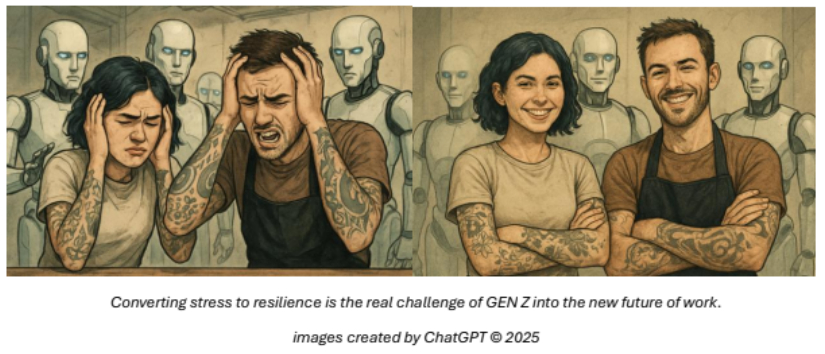
Let’s raise a toast to Generation Z, a remarkable group that exemplifies the power of turning stress into resilience. Their ability to transform adversity into strength is truly inspiring.
About the Authors